Overview
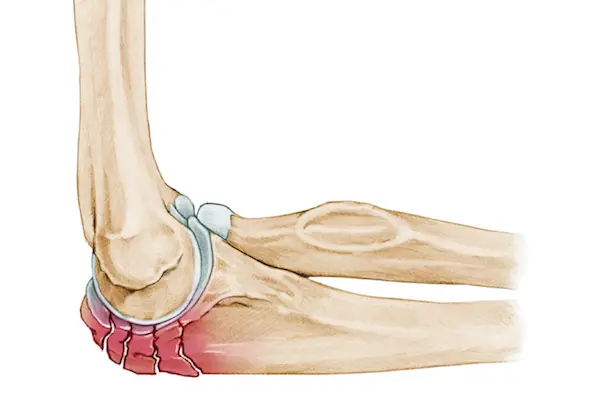
An Olecranon Fracture refers to a break or crack of the bony prominence at the tip of the elbow, known as the olecranon, which forms part of the ulna bone in the forearm. This distinctive bony point is easily felt beneath the skin and serves as a critical attachment site for the triceps muscle, the powerful muscle group responsible for extending and straightening the elbow. Because of its superficial position and minimal soft tissue coverage, the olecranon is particularly vulnerable to direct trauma or sudden impact, making injuries to this region both common and often severe.
From a clinical perspective, an Olecranon Fracture is regarded as one of the most frequently encountered elbow fractures in both emergency and orthopedic settings. It affects a wide spectrum of individuals — from older adults with osteoporosis, whose bones are more fragile and prone to injury, to athletes, manual laborers, and active individuals exposed to high-risk activities or repetitive stress on the elbow joint. Such fractures can significantly impair elbow function, daily activities, and overall upper-limb performance if not addressed promptly.
At DMPhysios, a premier Noida-based clinic specializing in spine and sports conditions and known for its patient-centered rehabilitation approach, Olecranon Fracture cases are managed using a combination of evidence-based treatment protocols, state-of-the-art physiotherapy, and highly individualized care plans. This ensures that each patient not only achieves optimal healing of the fracture itself but also regains full strength, mobility, and confidence in using the injured arm in their everyday life.
Symptoms
The symptoms of an Olecranon Fracture are usually immediate and severe due to the exposed location of the bone. Common signs and symptoms include:
- Sudden, sharp pain at the back of the elbow following injury
- Swelling and visible deformity over the elbow tip
- Inability to straighten the elbow or loss of active extension
- Tenderness to touch directly over the olecranon
- Bruising or discoloration around the elbow joint
- Numbness or tingling in the forearm or hand if surrounding nerves are affected
Recognizing these symptoms promptly is crucial, as untreated or poorly managed Olecranon Fracture can lead to chronic stiffness, weakness, or functional impairment.
Types of Olecranon Fracture
Orthopedic specialists classify Olecranon Fracture into different types based on the fracture pattern, displacement, and involvement of the joint surface:
- Non-displaced Olecranon Fracture
- The bone cracks but remains aligned.
- Usually treated non-surgically with immobilization.
- Displaced Olecranon Fracture
- The broken bone fragments shift apart.
- Often requires surgical fixation to restore alignment.
- Comminuted Olecranon Fracture
- The olecranon is shattered into multiple pieces.
- More complex to treat and typically requires surgery.
- Open (Compound) Olecranon Fracture
- The fracture is accompanied by a skin wound exposing bone.
- High risk of infection and urgent surgical management needed.
- Fracture with Elbow Dislocation
- The olecranon fracture occurs along with joint dislocation, further complicating treatment.
Understanding the type of Olecranon Fracture helps clinicians, including the team at DMPhysios, design the most effective management and rehabilitation plan for each individual.
Causes
The most common causes include:
- Direct trauma: A fall directly onto the elbow (e.g., during sports, a slip on a wet floor).
- Indirect trauma: Falling onto an outstretched hand with the elbow partially flexed.
- Motor vehicle accidents: High-impact collisions can transmit forces that fracture the olecranon.
- Sports injuries: Activities like cycling, contact sports, or gymnastics increase risk.
- Occupational hazards: Repetitive stress or heavy manual labor may predispose to stress fractures.
Risk Factors
While anyone can sustain an Olecranon Fracture, some factors increase the likelihood:
- Advanced age with brittle bones (osteoporosis)
- High-risk sports or physically demanding jobs
- Previous elbow injuries or deformities
- Poor balance or gait instability leading to falls
- Chronic conditions such as rheumatoid arthritis that weaken bone structure
At DMPhysios in Noida, risk factors are thoroughly assessed during initial consultations to create personalized prevention and rehabilitation plans.
Treatment
Management depends on the severity and type of fracture, patient age, and functional demands. Treatment aims to restore elbow function, alignment, and strength.
Non-Surgical Treatment
- Indicated for non-displaced Olecranon Fracture with intact triceps function.
- The arm is immobilized in a long-arm cast or splint at about 45–90 degrees of flexion.
- Periodic X-rays monitor healing progress.
- Gentle range-of-motion exercises may begin after 2–3 weeks under medical supervision.
Surgical Treatment
Required for displaced, comminuted, open, or unstable Olecranon Fracture:
- Tension Band Wiring (TBW): Most common technique for simple displaced fractures.
- Plate and Screw Fixation: Used for complex or comminuted fractures.
- Intramedullary Nail Fixation: For select cases to minimize soft tissue disruption.
- External Fixation: Reserved for severe open fractures with infection risk.
The goal of surgery is to achieve anatomical reduction, restore triceps function, and enable early mobilization to prevent stiffness.
Physiotherapy Treatment
Physiotherapy plays a pivotal role in the recovery journey after an Olecranon Fracture, whether treated conservatively or surgically. At DMPhysios, patient-centered rehabilitation ensures a smooth transition from immobilization to functional independence.
1. Initial Phase (Immobilization / Early Healing)
- Pain and swelling control: Cryotherapy, gentle massage, and elevation.
- Maintenance exercises: Isometric contractions of the biceps, triceps, and grip-strengthening to preserve muscle activity.
- Shoulder and wrist mobility: Active movements of adjacent joints to prevent stiffness.
2. Early Mobilization Phase (Post-Cast or Post-Surgery)
- Active-Assisted Range of Motion (AAROM): Gentle elbow flexion and extension within pain-free limits.
- Scar management: If surgery performed, scar massage and mobilization to prevent adhesions.
- Neuromuscular re-education: Reestablish normal elbow movement patterns.
3. Strengthening Phase
- Progressive Resistance Exercises (PRE): Focus on triceps, biceps, forearm, and grip.
- Closed-chain exercises: Wall push-ups, quadruped weight-bearing to enhance joint stability.
- Functional training: Gradual return to daily tasks like lifting, pushing, and reaching.
4. Advanced / Return-to-Activity Phase
- Sport-specific drills: For athletes recovering from Olecranon Fracture, such as throwing mechanics or weight training under supervision.
- Proprioception and coordination exercises: To reduce the risk of reinjury.
- Education: Posture, ergonomics, and joint protection strategies.
Role of DMPhysios
At DMPhysios, the rehabilitation program for Olecranon Fracture is tailored to each individual. Therapists combine manual therapy, advanced modalities, and exercise progressions with patient education, ensuring faster and safer recovery. Regular assessments track improvements and adjust the program as healing progresses.
Prevention
While not all injuries can be prevented, certain measures reduce risk:
- Protective gear: Elbow pads during high-risk sports or activities.
- Fall prevention: Balance training, proper footwear, and home safety modifications for older adults.
- Bone health: Adequate calcium and vitamin D intake, weight-bearing exercises to maintain bone density.
- Safe technique: Proper form during sports or occupational tasks to minimize stress on the elbow.
Incorporating injury prevention education is a standard practice at DMPhysios, especially for athletes and individuals with recurrent injuries.
Conclusion
An Olecranon Fracture is a significant injury that can affect the elbow’s ability to function properly if not treated correctly. Early diagnosis, appropriate medical care, and structured physiotherapy are key to achieving full recovery. The team at DMPhysios, a Noida-based clinic specializing in spine and sports conditions with patient-centered rehabilitation, provides comprehensive, individualized programs to help patients recover from Olecranon Fracture and return to their normal activities safely and effectively.If you or someone you know is experiencing symptoms of an Olecranon Fracture or recovering from one, don’t wait—reach out to DMPhysios today. Their expert physiotherapists and evidence-based rehabilitation programs can guide you every step of the way toward regaining strength, mobility, and confidence.