Overview
Femoroacetabular Impingement (FAI) is a musculoskeletal condition in which abnormal contact and friction occur between the femoral head (the “ball”) and the acetabulum (the “socket”) of the hip joint.
This repeated impingement, especially during movements involving hip flexion or rotation, can progressively wear down the protective structures within the joint.
Over time, this abnormal mechanics can lead to significant damage to the labrum (the cartilage ring that lines the socket) and the articular cartilage, increasing the risk of developing early-onset osteoarthritis of the hip.
While the hip joint is anatomically designed to allow smooth, multi-directional movement and absorb high functional loads, even minor structural irregularities can compromise its efficiency and longevity.
In many cases, these anatomical variations—such as a misshapen femoral head or an over-deepened acetabular socket—develop during adolescence but remain silent for years.
Symptoms often become noticeable only when joint structures begin to deteriorate, especially in active individuals or athletes who engage in repetitive high-impact movements like running, squatting, or pivoting.
At DMPhysios, a premier physiotherapy clinic located in Noida, specializing in spine and sports conditions, we regularly treat patients presenting with vague or persistent hip and groin discomfort. Through comprehensive clinical and biomechanical assessments, we have found that Femoroacetabular Impingement is frequently an underlying—but often overlooked—culprit behind these symptoms.
Early recognition of this condition is crucial. When identified promptly and managed through a structured, evidence-based rehabilitation plan, Femoroacetabular Impingement can be effectively treated, preserving joint integrity and preventing long-term disability.
Our team at DMPhysios is dedicated to providing patient-centered care that not only alleviates current pain but also addresses the root cause, helping patients return to a more active, pain-free lifestyle with confidence.
Symptoms
The symptoms of Femoroacetabular Impingement can range from mild discomfort to debilitating pain, depending on the severity and duration of joint stress. Common symptoms include:
- Deep, aching pain in the groin or front of the hip, especially after prolonged sitting or walking.
- Sharp pain during certain movements such as twisting, squatting, or getting out of a car.
- Stiffness in the hip, particularly noticeable in the morning or after rest.
- Sensation of the hip joint clicking, catching, or getting stuck during movement
- Decreased range of motion, especially during hip flexion and internal rotation.
- Pain that may radiate to the buttocks or the side of the hip in advanced cases.
Symptoms may worsen over time, especially in athletes and individuals with an active lifestyle who continue high-impact activities without addressing the underlying issue.
Types of Femoroacetabular Impingement
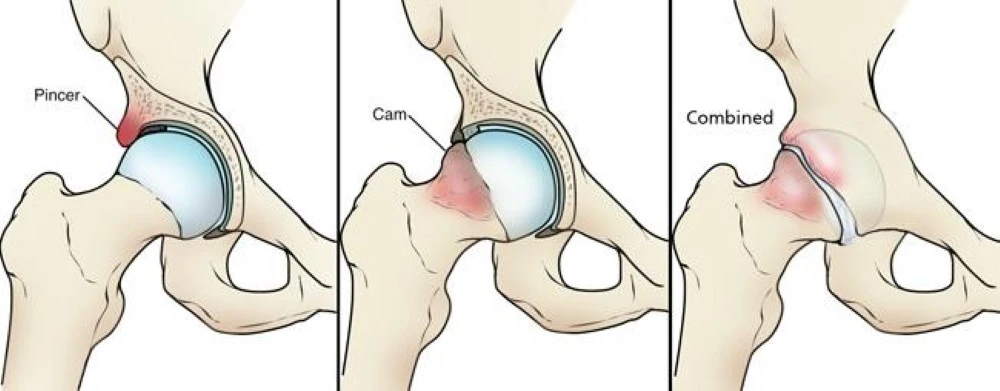
Femoroacetabular Impingement is categorized based on the structural deformity causing the abnormal joint contact:
1. Cam Impingement
In this type, the femoral head is not perfectly round, leading to increased contact with the acetabulum during movement. This occurs mostly in young, athletic males and can result in cartilage delamination and labral damage.
2. Pincer Impingement
Here, the acetabulum has excess coverage over the femoral head. This causes the labrum to be pinched between the two bones during hip motion. It’s more common in middle-aged women.
3. Combined Impingement
Most individuals with Femoroacetabular Impingement have a combination of both cam and pincer lesions. This dual pathology increases the risk of severe joint damage if not addressed early.
At DMPhysios, our evaluation process includes clinical and radiological assessment to determine the exact type of impingement so we can design the most effective treatment strategy for each individual.
Causes of Femoroacetabular Impingement
The causes of Femoroacetabular Impingement are often linked to subtle anatomical changes that develop during growth or are acquired later in life. Key contributing factors include:
- Developmental bone abnormalities: Slight irregularities in bone shape formed during adolescence.
- Repetitive high-impact activities: Sports that involve extreme hip flexion, rotation, and cutting movements (e.g., football, hockey, gymnastics).
- Previous hip trauma or surgery: Injuries or surgical interventions that alter the normal anatomy of the hip joint.
- Poor biomechanics and posture: Abnormal movement patterns that increase stress on the joint.
- Genetics: A family history of hip issues may increase susceptibility.
The skilled physiotherapists at DMPhysios carefully assess both structural and functional components during evaluation to understand the true cause behind each case of Femoroacetabular Impingement.
Risk Factors
Certain factors increase the likelihood of developing Femoroacetabular Impingement:
- High-level sports participation from a young age
- Male gender, especially for cam-type FAI
- Females are more susceptible to pincer-type FAI
- Ages between 20–45, during which the condition typically becomes symptomatic
- Family history of hip problems
- Limited hip mobility or flexibility
- Occupations requiring deep squatting or prolonged sitting
At DMPhysios, we not only treat but also focus on educating patients about modifiable risk factors. Our preventive strategies help reduce the recurrence of symptoms and the risk of joint degeneration.
Treatment
The treatment of Femoroacetabular Impingement depends on the severity of the symptoms, the extent of structural changes, and the patient’s lifestyle demands. Treatment options include both non-surgical and surgical approaches.
1. Conservative (Non-Surgical) Treatment
For many patients, especially in early stages, conservative management can offer significant relief:
- Rest and activity modification: Avoiding aggravating movements such as deep squatting or lunging.
- NSAIDs (Non-steroidal anti-inflammatory drugs): To manage inflammation and pain.
- Targeted physiotherapy: To improve joint mobility, reduce muscular compensation, and strengthen surrounding musculature.
- Hip joint injections: Corticosteroid injections may help reduce inflammation and assist in diagnosis.
At DMPhysios, our emphasis is always on non-invasive treatment first. Our rehab experts closely monitor progress and adjust the plan based on individual responses.
2. Surgical Treatment
When conservative treatment fails or structural damage is advanced, surgery may be considered:
- Hip arthroscopy: A minimally invasive procedure to correct bony abnormalities, repair labral tears, and remove loose cartilage.
- Osteoplasty: Reshaping the femoral head or acetabular rim to reduce impingement.
- Labral repair: Fixing or reconstructing the damaged cartilage ring for better hip stability.
Post-surgical rehab is critical. At DMPhysios, we offer tailored post-op physiotherapy to help patients regain strength, function, and confidence.
Physiotherapy Treatment
Physiotherapy is the cornerstone of both conservative and post-surgical treatment for Femoroacetabular Impingement. At DMPhysios, our patient-centered rehab approach ensures individualized, progressive care. Here’s how we approach it:
Phase 1: Pain Management & Early Mobility
- Education: Patients are educated about avoiding provoking positions.
- Manual therapy: Gentle joint mobilizations and soft tissue release around hip flexors, adductors, and piriformis.
- Modalities: Use of Accelerated Healing Therapy or cryotherapy to manage inflammation.
- Mobility exercises: Gentle active range-of-motion (ROM) movements within pain-free range.
Phase 2: Core and Hip Stabilization
- Core activation: Deep abdominal and pelvic stabilizer training (e.g., drawing-in, dead bugs).
- Gluteal strengthening: Exercises like bridges, clamshells, and quadruped hip extensions.
- Isometric hip strengthening: For flexors, abductors, and rotators.
Phase 3: Functional Strengthening & Motor Control
- Dynamic control drills: Lunges, step-ups, resistance-band movements ensuring proper hip alignment.
- Balance and proprioception: Single-leg balance, BOSU training to improve neuromuscular control.
- Gait retraining: If gait alterations exist due to pain or compensations.
Phase 4: Return to Sport or Activity
- Agility and coordination training: For athletes aiming to return to sports.
- Sport-specific drills: Customized based on individual sports or performance goals.
- Load tolerance testing: To ensure readiness before returning to full activity.
Every phase is carefully monitored by our experienced physiotherapists at DMPhysios, making sure patients with Femoroacetabular Impingement progress confidently toward recovery.
Prevention
While not all cases of Femoroacetabular Impingement can be prevented due to congenital bone shapes, the onset and severity of symptoms can often be delayed or reduced with proactive measures:
- Avoiding repetitive extremes of hip motion, especially in growing adolescents
- Incorporating regular mobility and strengthening exercises
- Monitoring technique during squatting, lunging, and athletic drills
- Proper warm-up and cool-down routines
- Early screening for young athletes with a family history or signs of hip discomfort
DMPhysios offers preventive assessment services for athletes and young individuals who may be at risk, emphasizing education and early intervention.
Conclusion
Femoroacetabular Impingement is more than just a structural issue—it’s a functional limitation that can gradually diminish an individual’s quality of life if not treated. With proper diagnosis, timely intervention, and evidence-based rehabilitation, most individuals can return to full function and even excel in sports and active lifestyles.
At DMPhysios, a trusted clinic in Noida for spine and sports conditions, we specialize in treating Femoroacetabular Impingement with a patient-centered, movement-focused approach. Our team of physiotherapists, orthopedic consultants, and rehab experts work closely to ensure a complete recovery journey tailored to each patient’s goals.If you suspect you’re experiencing symptoms of Femoroacetabular Impingement, don’t delay your diagnosis. Contact DMPhysios today and let our expert team guide you through a customized rehabilitation program designed for lasting recovery and restored performance.